

 Türkçe
EDI IN THE SAP WORLD
THE SILENT POWER OF THE DIGITAL SUPPLY CHAIN
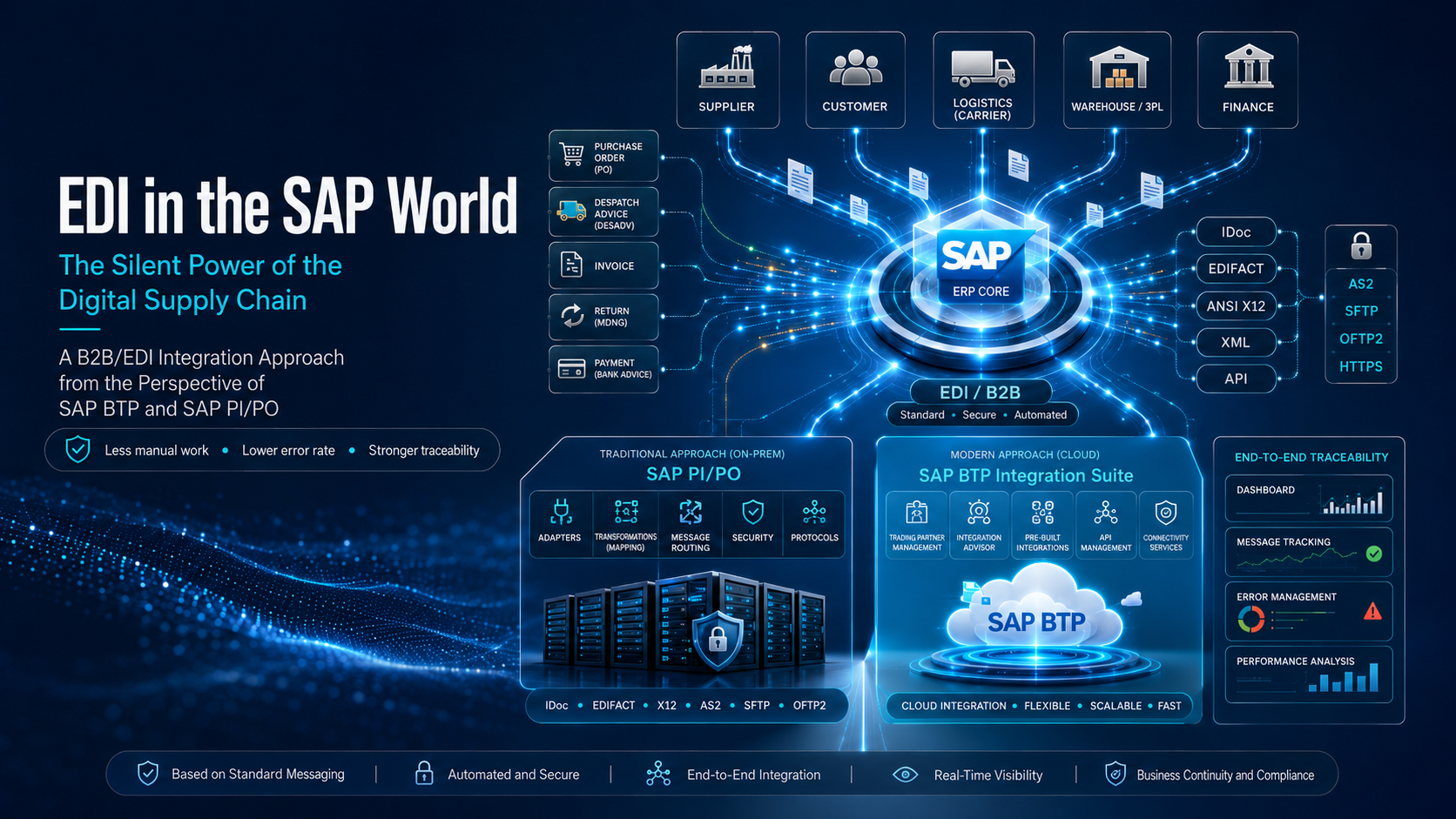
EDI in the SAP WorldThe Silent Power of the Digital Supply Chain |
B2B/EDI Integration Approach from the SAP BTP and SAP PI/PO Perspective
As companies grow, data exchange with business partners becomes more complex. Purchase orders, order confirmations, dispatch advices, invoices, delivery notifications, stock movements and logistics messages have become too fast, voluminous and critical to be managed through manual processes.
This is exactly where EDI (Electronic Data Interchange) comes into play. EDI is the technology that enables companies to automatically share business documents between systems in standard formats. In other words, EDI can be considered the digital business language established among customers, suppliers, logistics companies, distributors and production networks.
|
💡 Miacore Tip: In EDI projects, establishing a common language with your business partners reduces operational errors by up to 90%. A properly designed architecture gives your company global-scale agility. |
How Is EDI Positioned in the SAP Ecosystem?
In the SAP world, EDI is generally considered together with standards, message structures and communication protocols such as IDoc, EDIFACT, ANSI X12, XML, CSV, API, AS2 and SFTP. Although the topic may technically look like an integration flow, its business impact is much greater: the reliability of the operational chain from order to invoice depends directly on the EDI architecture.
The table below summarizes frequently used standard EDI messages, their industry formats, their SAP equivalents and the key benefits these flows provide to organizations:
|
Business Process |
Standard EDI Document |
International Format / Message Type |
SAP ERP Internal Equivalent |
Key Benefit |
|
Purchasing |
ORDERS (Order) |
EDIFACT ORDERS / ANSI X12 850 |
ORDERS IDoc / Enterprise Proxy |
Instant and error-free transmission of the purchase order to the supplier |
|
Sales |
ORDRSP (Order Confirmation) |
EDIFACT ORDRSP / ANSI X12 855 |
ORDRSP IDoc / Sales Order API |
Automatic processing of confirmations received from suppliers and increased speed |
|
Logistics |
DESADV (Dispatch Advice) |
EDIFACT DESADV / ANSI X12 856 |
DESADV IDoc / Inbound Delivery |
Full visibility in warehouse and goods receipt processes |
|
Finance |
INVOIC (Invoice) |
EDIFACT INVOIC / ANSI X12 810 |
INVOIC IDoc / LIV (Logistics Invoice) |
Reduction of manual invoice entry errors and reconciliation times |
EDI Use Cases: Why SAP Integration Solutions?
The management of EDI processes in SAP architecture varies according to the capabilities of the platform used and the maturity of the architecture. Although independent EDI/B2B integration tools such as IBM, Axway or Sterling exist in the market, SAP PI/PO and modern SAP BTP Integration Suite solutions are always one step ahead for organizations using SAP.
The main reason for this is that these tools offer out-of-the-box integration packages that are fully compatible with SAP’s own native architecture such as IDoc, RFC, ABAP Proxy and Standard Enterprise APIs. End-to-end data integrity is achieved much more securely and with a lower total cost of ownership (TCO), without additional connector costs, version incompatibilities or complex external mapping layers as in third-party tools.
|
🎯 Miacore Experience: The 'breakages after version updates' and 'monitoring difficulties' that we frequently observe in customers using third-party integration layers are completely eliminated in native SAP infrastructures. |
Architecture Approach 1
Traditional EDI Management on SAP PI/PO
|
In traditional architecture, EDI processes are managed via B2B Add-on components residing on SAP PI/PO. The flowchart and operational structure are as follows: [ Communication Layer ] Secure communication protocols such as AS2, OFTP2, and SFTP are terminated directly within this layer. [ Conversion (Converter) ] Messages received from external partners in EDIFACT or ANSI X12 formats are converted into SAP IDoc or Proxy structures via PI/PO's converter modules and then transferred to the ERP (ECC or S/4HANA) system. [ Operational Impact ] Although this structure is highly stable and robust, the completely manual maintenance of mapping rules and the need to configure every new business partner from scratch introduces an operational burden. |
Architecture Approach 2
Modern B2B/EDI Approach with SAP BTP Integration Suite
|
In the cloud-based modern architecture, EDI is moved to a much more flexible, intelligent and visual model with the advanced components offered by SAP BTP Integration Suite: ✦ Trading Partner Management (TPM): Business partner profile, certificate and protocol information is managed centrally. When a new supplier or customer is included in the system through partner onboarding, the process is completed within hours instead of days. ✦ Integration Advisor (AI-Supported): By having intelligent algorithms analyze industry standards such as EDIFACT and the organization’s SAP data structure, it automatically provides the most accurate mapping recommendations. It minimizes design time and the margin of error. ✦ Central Monitoring (End-to-End Monitoring): Full traceability is provided in B2B scenarios, allowing even non-technical operations teams to easily identify which validation rule an erroneous incoming EDI message failed. |
Why Is EDI Important in SAP?
For a company using SAP, EDI is not only a technical integration topic; it is the foundation of operational efficiency. A properly designed EDI architecture provides organizations with the following advantages:
-
Reduces Manual Workload: It eliminates processes based on manual data entry through e-mail, Excel or PDF and enables documents to flow automatically between systems.
-
Improves Data Quality: Thanks to standard message structures and validation rules, data received from business partners is managed in a controlled way. Master data consistency and order-invoice reconciliation are secured.
-
Accelerates Process Speed: Waiting times in the cycle from order to invoice decrease. Especially in manufacturing, retail, automotive and logistics sectors, this speed directly turns into a competitive advantage.
-
Enables Scalable Growth: When a new customer or supplier is added to the network, partner onboarding becomes short and repeatable by using standardized templates instead of designing the integration from scratch.
What Determines Success in EDI Projects?
Technology is important in EDI projects; however, the main factor that determines success is the right project approach. For a successful go-live, the following questions must be answered during the architectural design phase:
-
Which business documents such as orders, invoices and logistics documents will be integrated, and in which priority?
-
Which EDI format such as EDIFACT, X12 or XML and which protocol such as AS2, SFTP or API do business partners support?
-
In the target architecture on the SAP side, should IDoc, standard APIs or Enterprise Services be preferred?
-
How traceable and understandable will possible schema and validation errors be for both technical teams and operations teams?
|
🚀 Why Miacore? At Miacore, we reduce risks in EDI projects with both our deep experience in legacy PI/PO architectures and our global competence in SAP BTP cloud transformations. We do not only connect systems; we guarantee your business continuity. |
EDI Is Not an Integration Topic, It Is a Business Continuity Topic
Today, EDI is a critical building block for the uninterrupted operation of supply chain, sales, purchasing, logistics and finance processes. For companies using SAP, the right EDI architecture means less manual work, a lower error rate, stronger traceability and an infrastructure ready for the future.
Whether you optimize your infrastructure on your existing SAP PI/PO systems or move it to the intelligent cloud world of SAP BTP Integration Suite, a B2B strategy designed with the right steps carries your company into the future. What makes the difference in this critical transformation process is not only knowing the integration tool, but also mastering the deep SAP ERP data model and reading business scenarios correctly.
As Miacore, this is exactly where we step in. With the field experience we have gained from large-scale integration projects at industry-leading organizations, our technical depth in both legacy PI/PO and cloud BTP architectures and our expert team that translates business processes into technical language flawlessly, we become your most reliable business partner in your projects. With Miacore, we do not only connect systems; we prepare your supply chain for the digital age.